Key information
- 🕹️ Platforms: PC, PS5, Xbox Series X/S
- 📅 Release date: December 10, 2020
- 🏢 Developer / Publisher: CD Projekt Red
- ⏱️ Playtime: 40–100+ hours
- 🧪 Genre: Open-world RPG, action, cyberpunk
- 🏆 My verdict: 7/10 Johnny Silverhands
Let’s get one thing straight. Cyberpunk 2077 isn’t some indie project built on enthusiasm alone, or a solo developer’s dream realized through years of struggle. Cyberpunk 2077 is a AAA production, backed by one of the industry’s biggest studios, CD Projekt Red, with a budget that could probably cover a small country’s annual GDP. This is a studio with The Witcher 3 behind it, millions in funding, hundreds of employees, and almost a decade of development. The bar isn’t just high; it’s in the stratosphere.
At this point, I’ve spent more than 200 hours in Night City. That’s less a boast than an admission that I’ve given this game far more chances than most people did after its disastrous 2020 launch. And honestly? It was worth it. Sort of…
Here’s the thing: Cyberpunk 2077 isn’t the masterpiece everyone desperately wanted it to be, and pretending otherwise does nobody any favors. It’s good now, sometimes great, occasionally brilliant, but it doesn’t sit on my top shelf beside Baldur’s Gate 3.
The promise
Remember the hype? CD Projekt Red, fresh from The Witcher 3, ready to redefine open-world RPGs again. Cyberpunk, that philosophical beast born from Gibson’s Neuromancer and Ridley Scott’s rain-soaked streets, was finally getting the AAA treatment it deserved. We were promised a living, breathing metropolis where every choice mattered, where corporate scum and street samurai collided in a morally grey war.
“Although, believe me, we never intended for anything like this to happen.”
— Marcin Iwiński, CD Projekt Red co-founder, An important message from our founders
What we got in December 2020 was… a complete mess. Hourly crashes. NPCs frozen in T-poses or flying into oblivion. Police spawning behind you like something out of a bargain-bin horror game. Console versions running at what, 15 FPS? It was broken in a way that felt almost insulting, considering the years of development, the marketing noise beforehand, and the hefty price tag.
But I’m not here to stay angry about the past. Plenty of people have done that for me. What interests me now is what Cyberpunk 2077 has become after CD Projekt Red spent years on patches, updates, and eventually Phantom Liberty. Has it redeemed itself? Partly, yes. Is it what we were promised? Not even close. But it’s worth your time now, especially if you enjoy dystopian science fiction and can accept a world that looks better than it feels.
Night City: a beautiful corpse
A visual masterpiece
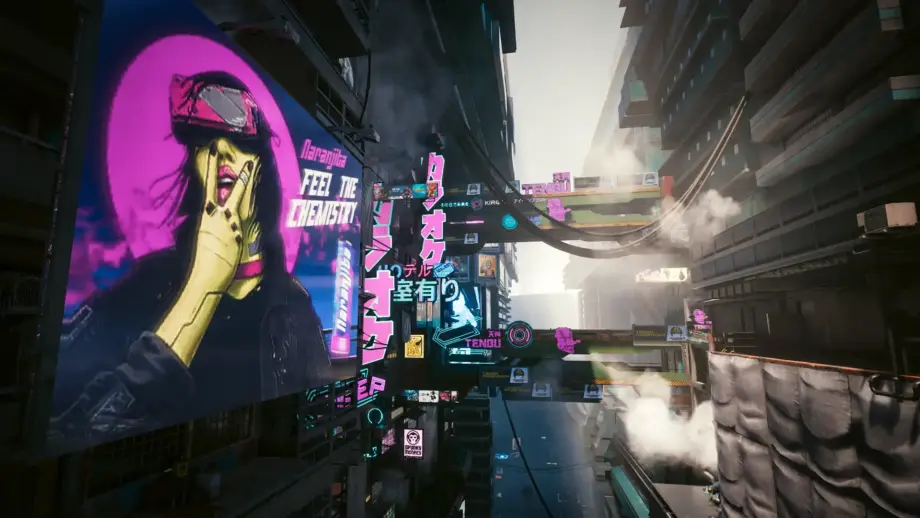
Visually, Night City is genuinely impressive. The architectural density, the layers of vertical space, the advertising shouting at you from every corner: it looks right. The neon-soaked aesthetic is there, the corporate surveillance state feels tangible, and walking through neighborhoods such as Japantown or the combat zones feels exactly as it should.

Environmental storytelling is at its best here. Graffiti tells stories. Back alleys hide secrets. The verticality makes you feel trapped in an enormous steel-and-concrete cage, perfectly capturing the cyberpunk spirit. Light and shadow play across wet asphalt, while the soundscape hums with industrial melancholy. You can stand on a rooftop at sunset, watching layers of city stretch toward the horizon, and feel that you’re somewhere something exists.
This city wants to swallow you whole, and visually, mission accomplished.
An empty core
Here’s where it falls apart, though: NPCs are essentially mannequins with dialogue lines. They follow predetermined paths, disappear when you aren’t looking, and respond to violence with the emotional depth of cardboard cutouts. You see the same cowering animation dozens of times. After a while, you stop seeing people and start seeing code.
Compare it with Red Dead Redemption 2. Yes, I know: different scale, different engine. But its people actually exist beyond decorating the scenery. RDR2’s NPCs remember you. They respond to the weather, time of day, and your reputation. In Night City? They’re props. Very pretty props, but props all the same.

There’s simply no world simulation:
- The economy doesn’t matter (you’ll be swimming in eddies by hour 20).
- Police AI remains laughably bad even after the fixes, although it’s better than the teleporting cops at launch.
- Outside scripted quests, the city feels static.
- Traffic patterns are artificial, and NPCs have no schedules or routines.
- You can’t meaningfully interact with 99% of what you see.
You don’t live in Night City; you’re on a tour. From a studio with CD Projekt Red’s resources? That’s disappointing. Cyberpunk was supposed to set the standard for open-world simulation, rather than give us an expensive stage set.
Combat and other gameplay systems
The good
Cyberpunk 2077’s gameplay is where things get more interesting. There’s shooting, hacking, stealth, and melee: choose what you like and build around it. Cyberware lets you turn V into a Mantis Blade-wielding maniac or a netrunner frying brains from the shadows. Conceptually, it’s solid, and when it works, it really works.
I played most of the game in melee because, honestly, nothing beats knowing that the last thing your enemy saw was your katana cutting through the neon haze. There’s something primal about closing the distance while bullets bounce off your subdermal armor, then slicing through three fools before they can reload.
Sandevistan turns you into a chromed-up god of death, slowing time while you carve up enemies as if they’re standing still. I didn’t use it, though. Too easy and too boring, especially paired with the Byakko katana.
Build variety
Since Update 2.0, character builds actually matter. Pick what appeals to you:
- Netrunner: hack everything and spread quickhacks like a digital plague without firing a shot.
- Solo: a tank build with a Berserk operating system. Take damage to the face and punch through walls.
- Stealth assassin: silenced weapons, Optical Camo, and missions completed like a ghost.
- Tech specialist: Smart weapons and electromagnetic rifles that shoot through cover.
- Melee maniac: katanas, Mantis Blades, or Gorilla Arms for pure close-quarters chaos.
The skill trees were restructured to make sense. Early-game balance was awful: you could break everything by the ten-hour mark. Later patches fixed much of that. Now your choices have weight, and specialization has consequences. You can no longer be good at everything, which pushes you toward a particular playstyle. That sounds like an RPG, and I’m pleased about it.
Where immersion dies: stealth
Then there’s stealth… I enjoy sneaking through enemy bases as much as anyone. Dishonored and Deus Ex taught me well. But Cyberpunk’s stealth system is shallow in ways that honestly surprised me. Lighting doesn’t matter. Weather doesn’t matter. Shadows are purely decorative.
Meanwhile, you can stand in pitch darkness during a thunderstorm and be spotted instantly if the game decides you aren’t behind the right cover. It’s binary.
You can crouch in a brightly lit corridor and go unseen, provided you’re technically “hidden” according to the interface. Meanwhile, you can stand in pitch darkness during a thunderstorm and be spotted instantly if the game decides you aren’t behind the right cover. It’s binary: detected or undetected, without accounting for environmental conditions that absolutely should affect visibility.
Compare that with games that respect environmental stealth mechanics. In Splinter Cell, you used the shadows. In Thief, you needed darkness. Hell, even Skyrim had basic light detection, although admittedly that’s a low bar. Cyberpunk 2077 just… doesn’t care. Pouring rain? It doesn’t reduce enemy visibility. Thick smog across the street? Nope, they can see you perfectly. Standing in total darkness? No help unless you’re crouching behind an object.
The system runs on proximity and line of sight, nothing else. It’s functional for basic sneaking, but there’s no depth or strategy beyond “stay behind cover and crouch.” For a game obsessed with cybernetic enhancements and tactical options, stealth feels strangely disconnected from its world.
What else feels strange
Shooting feels decent, and better after the updates, but it can become repetitive. Hacking is where the philosophy really comes through. You’re manipulating systems, turning the city’s own infrastructure against it. Again, though, it’s too powerful once you understand how it works. Late-game netrunners can clear entire buildings without entering them, which is wildly overpowered. Power without consequences gets boring quickly. They could have added more enemy netrunners and sped up their quickhack uploads… but no.
The story: noir with tears on demand
The main narrative
The central story is strong. V is slowly dying while sharing headspace with a dead rock-star terrorist, and it hits hard when it wants to. It’s noir, melancholy, and fatalistic.
The writing handles moral ambiguity well. Characters have depth, and dialogue usually doesn’t sound like a video game script. The chip’s ticking clock adds a sense of doom most open-world games fail to achieve.


But here’s my complaint: these characters often feel too emotional, too strained. The game wants you to care so desperately that it sometimes slides into melodrama. Every major character has a tragic backstory or a big moment designed to make you feel. Judy has her trauma, River has his, Panam has hers, all dialed up to maximum, as if they’ve just escaped a psychiatric hospital and run out of medication. How do they even survive in a cyberpunk world with such fragile nerves? 😀 After a while, it’s exhausting.

I appreciate good writing, but there’s a difference between earned emotion and manufactured sentimentality. Dragon Age: Origins knew how to let its characters breathe without constantly demanding tears or throwing hysterical people at you.
Cyberpunk 2077 feels as if it’s holding your hand, pointing at a sad moment, and saying, “See? SEE? You’re supposed to cry now.” Sometimes it works. Kerry’s questline genuinely moved me. Often, though, it feels like cheap manipulation.
Johnny Silverhand: the character they got right
Johnny Silverhand is a standout. His ideological friction with V creates real tension. He’s an asshole, a hypocrite, a revolutionary who failed spectacularly and refuses to admit it. He loudly advocates destroying corporations while being Night City’s most self-centered narcissist. That hypocrisy makes him fascinating.
The dynamic between the player and the engram explores transhumanism, identity, and mortality in ways most games wouldn’t dare touch. Are you V with Johnny’s memories, or Johnny wearing V’s face? Where does consciousness end and programming begin? Those questions matter, and the game doesn’t always offer easy answers.
Keanu’s performance works too. He isn’t trying to be Neo or John Wick here. Johnny is bitter, angry, and haunted by his failures. It works: he actually feels like a character from the cyberpunk genre and the game’s world.
Side content and quests
Side quests range from brilliant to instantly forgettable:
The quality is inconsistent, but when it lands, it lands. Cyberpunk’s best side content can compete with anything in modern RPGs, sometimes even matching Oblivion’s guild quests. The worst feels like filler to justify the open-world structure.
Technical evolution
At launch, the game was unplayable for many people. The current version is more stable. Not perfect, but stable. Frame rates hold up: I get 100+ FPS on my setup, which is what I need. Crashes are rare, and visual bugs still exist without constantly breaking immersion.
Graphics and performance have been refined. Lighting looks better, ambient occlusion adds proper depth, and ray tracing, if you can enable it without dropping to 30 FPS, really improves the atmosphere. Reflections in puddles, neon bleeding across chrome surfaces, shadows that behave like shadows: this is what the game should have been at launch.
The launch scars remain, though. AI quirks still appear: odd NPC pathfinding, random physics glitches, cars falling from the sky when you summon them. Improvements to world simulation are minimal. You can see where the foundations cracked, even if the surface has been repainted. Some things can’t simply be patched; they needed better planning from the start.
For a studio that delayed the game several times, this should have been its launch condition. It shouldn’t have needed a redemption arc.
Phantom Liberty: when they finally figured it out
What changed
Phantom Liberty is where Cyberpunk 2077 finally becomes what it should have been from the beginning. A tighter structure, a spy-thriller tone, and real pacing instead of chaotic sprawl. Dogtown feels different from Night City proper: military occupation and tense survival replace neon excess.
Update 2.0, which arrived alongside it, reworked perks, improved AI, refined combat, and added the Relic skill tree. Character progression finally feels meaningful. Choices have weight. Skills interact in interesting ways. The expansion doesn’t simply add content; it repairs foundations that should have been solid before the base game launched.
Dogtown’s atmosphere
The base game shows corporate glamour and street chaos; Dogtown shows what happens when the system collapses entirely. Kurt Hansen’s Barghest militia runs the place through violence and intimidation. Refugees scrape by in bombed-out hotels. “Combat zone” isn’t a metaphor here: it’s a literal war frozen in uneasy waiting after a fragile peace.

Thematically, the DLC is about rebirth. V gets another chance to survive; CD Projekt Red gets another chance to salvage its reputation 😃. It isn’t perfect, but they finally made the game they promised, compressed into 20 hours of focused storytelling.
Modding: when players fix your game
Why modding matters here
Cyberpunk 2077’s modding community has done serious work fixing things CD Projekt Red couldn’t or wouldn’t address. Through a huge range of mods, modders turned a good game into a great one, which is both impressive and cause for questions.
Should we really need mods to fix a AAA game’s basic systems? That remains an open question.
How mods change the experience
Mods don’t just polish the experience; they fundamentally change how Night City feels. Improved police turn law enforcement from a joke into a real threat. Commit crimes and you face escalating consequences.

Modding tools released in 2025 unlocked real creativity. Community creators can now develop content that feels native to Night City’s aesthetic rather than like an obvious external addition. Quest mods, new cyberware, expanded romances: the community is building what CD Projekt Red should have included.
Visuals and sound: cyberpunk’s neon symphonies
Art direction that delivers
The art direction is fantastic. This is one area where CD Projekt Red absolutely realized its vision. Post-launch refinements improved lighting contrast, density, and environmental detail.
You can stand on a rooftop and simply look at the city, watching layers of advertising and the traffic flowing below, and it works. I even took a few screenshots during my playthrough.

The game’s use of cyberpunk imagery balances respect for the classics with contemporary style. Night City clearly draws inspiration from Blade Runner and Ghost in the Shell while establishing its own visual identity.
Sound design as emotional architecture
The music and sound design are excellent. Industrial beats, melancholy synths, human voices cutting through mechanical noise.
Audio cues build the atmosphere. Gunfights sound different in alleyways and open plazas. The voice acting makes events believable, although some supporting characters sound as if they recorded their lines in a different room.
Phantom Liberty shifted the aesthetic balance toward grounded tension rather than flashy excess. Dogtown’s soundscape emphasizes military occupation and urban decay.
This is one area where CD Projekt Red absolutely delivered on its promise.
Cyberpunk’s main themes: chrome without consequences
What the game is trying to say
Under the bugs and broken systems, Cyberpunk 2077 is trying to say something. Transhumanism, commodified freedom, memory as identity, technological salvation as an illusion: these aren’t simply decorations. The game asks uncomfortable questions about power, control, and what remains human when flesh becomes a commodity.

The chip is the game’s central metaphor. Johnny Silverhand’s digital resurrection forces both V and the player to confront questions about the continuity of consciousness. Is a digitized personality real life or an elaborate simulation? If your memories can be copied, what makes you you?
The game suggests those boundaries no longer matter in Night City. Nobody questions the ethics of cyberware implantation anymore; it’s just another product.
Where it falls short
Compare it with earlier cyberpunk works: Neuromancer, Blade Runner, Ghost in the Shell. Those stories are darker, harsher, and more grounded in existential horror. I prefer Blade Runner’s rain-soaked melancholy and quiet dread. That film understood that cyberpunk is about what we lose as technology advances, rather than what we gain.
Night City is too loud, too colorful, too eager to make you feel cool rather than complicit. It’s cyberpunk filtered through AAA game design and marketing.
Night City is too loud, too colorful, too eager to make you feel cool.
The game wants you to feel like a badass chromed-up samurai when you should feel like a desperate survivor in a dying world. That’s the disconnect. Blade Runner made you watch a person realize he wasn’t real. Neuromancer made cyberspace feel alien and dangerous. Cyberpunk 2077 makes it all feel like an action movie with philosophical ambitions. Maybe that’s exactly what it is?
Still, when the game slows down, through quiet conversations with Johnny, reflective moments before the endings, or side stories about broken people in a broken world, it remembers what cyberpunk actually is. Those moments are simply too rare, buried beneath hours of shooting and looting.
Endgame and replayability: what’s left after the ending?
There is post-story content: gigs, NCPD activities, and encounters scattered around the map. Honestly, though, it’s thin. Once the main story ends, Night City feels emptier than ever. Your legacy doesn’t really persist beyond quest flags and occasional NPC dialogue.
Replayability comes from different builds and story choices rather than a world reacting to you. There are several endings, some particularly devastating, such as the brutal suicide ending, and others more hopeful, such as Panam’s. They’re worth seeing, but the road to them feels much the same the second time around.
There are hidden secrets, though. Easter eggs everywhere, environmental puzzles, bits of lore that reward exploration. Tarot graffiti tells Misty’s story. Braindance recordings show what happened before you arrived.
I’ll probably replay it someday with a different build, but I’m in no hurry to return.
My verdict: good, but far from the promised masterpiece
Cyberpunk 2077 has evolved from fractured ambition into a coherent vision. It’s no longer the disaster of 2020, but neither is it the masterpiece CD Projekt Red promised or fans desperately wanted. It’s a good game now, sometimes great, occasionally brilliant, but always carrying the weight of what it could have been.
After 200+ hours, I can recommend it. The main story is excellent, combat becomes satisfying once you find your build, and Night City looks incredible. If you love dystopian science fiction and can accept a world that looks better than it feels, there’s plenty here to enjoy.
After 200+ hours, I can recommend it.
For a studio with CD Projekt Red’s talent, resources, and time? Cyberpunk 2077 should have been legendary. Instead, it’s just… good. Really good in places, disappointingly mediocre in others.
Redemption doesn’t erase failure, but it can give failure a purpose. Cyberpunk 2077 found its purpose; it just took four years longer than anyone expected. That’s the real tragedy. Not that it failed initially, but that we all knew it could have been so much more.
The game works now. It’s stable, beautiful, mechanically solid, and occasionally profound. That’s enough to recommend it. Just don’t expect the revolutionary experience the marketing promised.
Your questions, chooms: answers here
How much has Cyberpunk 2077 improved since launch?
The difference is striking. Years of patches and the comprehensive 2.0 update finally brought the game closer to the condition it should have launched in. Core systems, including perks, police AI, and cyberware, have been reworked, turning a fragmented, frustrating mess into a cohesive and enjoyable experience.
What's included in Cyberpunk 2077: Phantom Liberty?
Phantom Liberty is more than extra content; it realizes the original vision. The expansion delivers a focused spy thriller set in Dogtown, a decaying, dangerous district of Night City. It adds memorable characters, the new Relic skill tree, and some of the game's most engaging quest design.
Does Cyberpunk 2077 finally run well on consoles and PC?
On current-generation hardware, PC, PS5, and Xbox Series X/S, the game is now stable. The catastrophic crashes and frame-rate problems of 2020 are gone, leaving a smooth, visually impressive experience. That stability is the result of years of fixes, though.
Is Cyberpunk 2077 still buggy?
The game-breaking bugs are behind it. You won't face constant crashes or T-posing NPCs, but traces of the flawed foundations remain. AI pathfinding can still act up, physics glitches occasionally appear, and world simulation retains a certain emptiness. It's no longer “buggy” in the conventional sense, but it's far from flawless.
What makes Cyberpunk 2077 different from other science-fiction RPGs?
Cyberpunk 2077's uniqueness lies in its contradiction: Night City is a visually impressive, dense, fully realized cyberpunk metropolis, yet the world is empty beneath the surface. NPCs are mostly props, and systemic interaction is limited. No other game captures this neon-soaked atmosphere so thoroughly, making it simultaneously one of modern RPGs' most impressive and most superficial open worlds.